Showing posts with label Research. Show all posts

Sunday, 23 April 2017

Audience Expectations

'What would you expect from a drama Thriller film?'


Robin Fletcher - 17
"I would expect a drama/thriller film to have a very muted colour pallet                 
and be quite dark in colour and in themes."


Sophia Hill - 26

"I would expect a drama/thriller film to be quite slow but also intensely emotional, 
talking about quite difficult themes"


Anastasia Atkins - 22


"I think drama/thrillers should usually be about families,
family dynamic dramas"


Harriet Hale - 19

"I would expect it to be a film about emotional issues that are not usually dealt 
with, such has domestic abuse or suicide, which still has the ability to keep you on the 
edge of your seat"


Oliver Clark - 15
"Drama/thrillers are normally films with interesting, smart story lines but 
which are also very emotional about important issues"


Charlie Thornton - 27

"I expect thrillers to be serious and dark, so with lots of black and grey colouring"


Jay Barnett - 23

"Drama/thrillers usually deal with deep, emotional topics, like abuse, but still keep you questioning what happens next"


Joseph Sims - 29

"I expect suspense and anticipation, so that I don't get bored halfway through"
"Dramas and thrillers are always gripping until the very end"


Madison Howell - 16

"They're never set in one room, that's what keeps you watching...sometimes the setting makes it more interesting"


Holly Butler - 19
"I would expect a plot twist because you always want the good guy to win in the end"

Target Audience


As we had already done research into openings similar to the one we want to make, we knew that the films our target audience would most likely enjoy were psychological thrillers and critically acclaimed films such as 'Room', 'Silence of the Lambs', and 'One Flew Over the Cuckoo's Nest'.
We also thought that they would watch similar, well known T.V. programmes with complex storylines such as 'Westworld', 'Luther' and 'Game of Thrones'.


We thought that it would be important to think about what music they would listen to, as music can often be used as a signifier of a genre. We decided that this would be popular yet meaningful music such as 'Green Day', 'Ed Sheeran' and 'Adele'.

When deciding on our target audience, we tried to create as detailed a profile of them as possible. Therefore, we considered not just what films they would enjoy but also their age, lifestyle and other interests.

From this we thought that our target audience would be 15-30 year olds of any gender and likely to be working or middle class.

Production Company Logo Research

Before creating our own production company logo, we looked into famous production companies and their logos which are used in movies. We looked at the main features of their logos including; colouring, font and animation.


The Weinstein Company      


The Weinstein Company introduction is kept
short with the logo being the only thing featured.
The logo fades in and out and then fades out at
the end of the intro. This draws the viewer's
attention in and makes the logo stand out. The
company name is also the last thing seen during
this fade out.  The background is black which
makes the white logo bolder. The logo is kept
simple and only features three triangles
Music is played in the background of the
introduction which makes it seem more dramatic
and grabs attention. This logo shows that we do
not need to over complicate our own production
company intro/logo.


Miramax Films


Miramax's production company logo focuses
more on the animation than the actual logo. It has a big introduction with a sweep through a city. Its actual logo only appears in the last couple of seconds of the introduction. We are not going to be able to do this kind of animation as we do not have the skill or the time. The Miramax logo is kept very simple with a black background and a bold white font. The word 'Miramax' is the biggest word as it is the name of the company so it needs to stand out. Music is played in the background to make it seem more dramatic. We could use some sound in ours but it would only be impactful if it was an animation.


Metro Goldwyn Mayer


Unlike the others, MGM has remained simplistic when it comes to animation and sound. The only moving part of this logo is the lion in the middle which roars. The actual logo is complicated with many artistic pieces added. It takes up the whole screen and is balanced on both sides. The background is black which makes the golden-orange colour of it stand out. The production company's name is the biggest part of the logo so it stands out. We will most likely keep our logo design simple and less decorative but MGM's logo intro showed that if we were to make our logo animatic then keeping it simple works too.


Our own production company logo/introduction should be kept short to hold attention but also due to the limited skills and time we have. It is most common for the logo to be featured on a black background with bold lettering to make the name stand out. If the logo were to be an animation  sound (most likely music) should be added. If there is no movement sound should not be added and it should be kept a still.

Wednesday, 30 November 2016

Representation of Mental Illness in Films

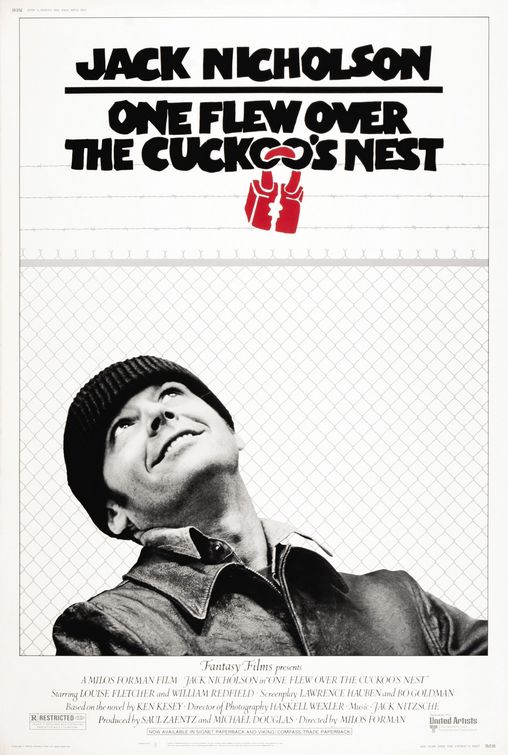
For our film opening coursework, our group decided on having the protagonist suffering from a mental illness. We have to take into account the representation of mental illness in our opening and try to make it as true to real life as possible. To do this we looked at examples of films which have incorporated mental illness. I have researched 'One Flew Over the Cuckoo's Nest' (1975) and 'Mary and Max' (2009). These two films represent different examples of mental illnesses in their own way.


Old Representations:

One Flew Over the Cuckoo's Nest (1975) - 

'One Few Over the Cuckoo's Nest' shows a  progressive view of mental illness, considering when the film was made.

The film highlights the injustice of the psychiatric field in the 1960s. This injustice is demonstrated through the film's protagonist, Randle McMurphy, who is locked away after faking madness to get out of hard labour. Despite this, a lobotomy is ordered by the doctors who are meant to be caring for him.

This film forces the audience to question who is and is not 'mentally ill'. Since the 1970s, treatment of the mentally ill has vastly improved, but the film has a similar impact today as it would have done 40 years ago as it breaks down the wall between 'normal' and 'abnormal'.

Within 'One Flew Over the Cuckoo's Nest' society clearly has a lack of respect for the mentally ill, as they are seen as a threat. The workers at the institution see them as animals which they can poke and prod at will. This creates a sense of sympathy in the audience, but also creating a respect for those suffering from mental illness.

This progressive representation is very different to the typical regressive representation of the mentally ill in the older examples. These would often portray mentally ill people as outcasts of society, forced to take medication to change who they are.


New Representations:

Mary and Max (2009) - 

Modern films tend to have a more progressive outlook on mental illness, a good example of this is 'Mary and Max'. At first the characters' mental illness is very subtle as it is not made explicit and is just a part of their personality. The film covers the various hardships of having a mental illness. Mary, an eight-year-old girl from Australia, suffers with depression and Max, a 44-year-old obese man from New York, has Asperger syndrome. 

The world in which the film is set is show through the minds of the two main characters, demonstrating the harsh reality of mental illness. However, despite this it brings the two together who find friendship as they send letters back and forth over the course of several years, forming a close bond due to their various shared mental and social problems. This is heart-warming for the audience and creates a sense of normality around their mental issues as they value their friendship just as much as anyone else would despite their quirks.

It is not just the two main characters that have mental or social issues/differences. In fact, early all of the characters have some sort of issue whether it be physical or mental. Mary's mother has a severe drinking problem, as well as kleptomania (the inability to refrain from the urge to steal things). Her neighbour has agoraphobia (an anxiety disorder that leads to the person perceiving an environment as unsafe with no easy way to get away), and Mary's Greek Australian neighbour, who she later marries, eventually turns out to be homosexual (not a mental illness or social issue but was not a social norm in the 60s when this film is set).

The film covers a vast number of themes surrounding mental illness, such as; childhood neglect, friendship, loneliness, obesity, suicide, isolation and anxiety. However, because these themes are covered from the perspective of the characters, they are not skewed or restrained. This is very progressive in terms of giving the audience an accurate representation of mental illness within the film.


Preliminary Task

In this task we were required to create our own short scene that demonstrated at least one example of the following shots:

  • Match on action
  • Shot-reverse-shot
  • 180-degree rule


Storyboard:


During the drawing of the storyboard, we decided against the use of any pan shots due to the limitations of equipment as all we had was a tripod and a phone. This meant that these kind of shots were likely to be shaky and inconsistent. Throughout the scene we used various examples of mid-shots and close-ups as these were essential in showing the emotion of our two characters within the film. 

Each shot on the storyboard displayed the rough duration of the shot; where it would be shot (interior/exterior); the shot type; the action happening within the shot; the sound within the shot and the type of transition/edit. 

Filming:

Some changes were made during the filming that differed to what was displayed on the storyboard. One major decision was the removal of dialogue within the scene. We came to this decision as we felt that our lack of acting experience could lead to the talking sections feel tacky. Another limitation which lead to this decision was the fact we were only able to use the in-built mic of the phone, and we felt that the audio wouldn't have been up to scratch. This decision also meant that we could demonstrate the emotions of the characters through visuals in the use of close-ups and facial expressions. If pulled off well, this could make it quite effective and I feel that we did this well. It also meant that the film could potentially be more humorous as the expressions on the characters' faces portrayed their emotions in a funny way.

During the filming we had to be conscious of continuity throughout, especially with the positioning of the two characters. An example of this is when Cassidy begins to walk across the room. Before this shot she is shown with her mouth open in a close up. When it cuts to the long shot of her walking along the room we had to make sure that she began the movement with her mouth open and looking in the same direction. For each shot we made sure to over-shoot, this made sure that the flow of the movements in the scene was consistent, and it also meant that reshooting would not be necessary as there was no lack of footage in each shot. 

One thing we didn't worry about too much during the filming process was the sound (particularly the ambient sound), as we knew that this could be tampered with in editing, and the fact we chose to have no dialogue made this process much smoother. 

There are some slight differences between the storyboard and the finished product. One example is when Cassidy walks towards the main door of the media room in the mid shot. On the storyboard it shows her coming towards the door from the left, however in the filming we chose to change this to the right as it wouldn't match with the first establishing shot of her walking along the corridor. If we kept it as it was in the storyboard the movement wouldn't have felt smooth and would've been disorientating, as well as a continuity error. Another example are the shots where Cassidy walks in and out of the Mac suite. On the storyboard it shows her walking in as the camera is looking over Molly's shoulder, but we chose to change this so that the camera angles were more interesting and varied. 

Editing:

Overall the editing was a smooth process, with our choice of having no dialogue helping in this. First we focused on cutting the clips before we thought about tampering with the sound (e.g. adding music, altering the ambient sound), as well as the visual effects (crop-lines & colour correction). As we had several takes on some of the shots from the filming, we had to go through the footage and selecting the best take per shot before we put them on the timeline. This meant that when it came to actually putting the clips together it would be a lot easier. 

We then made a rough cut of all the shots we wanted in the correct order together, and then focused on matching the action per shot. This was simple and just required going through the last few and the first few frames of the shots we selected on the rough cut. After we were happy with the cutting of the film, we then focused on the sound.

The sound was mostly simple to edit as we had no dialogue, but we did not want to skip over it. For example, in the shot where it is a close-up of Cassidy as she has just opened and walked through the door, there was no actual sound of the door closing in the background. This was fixed by looking through some of the takes that we had not included in the edit and finding a clip where the door closed. In this case we took the audio from one of the takes where she is walking through the door from the corridor. We simply overlaid the audio that we took from the other take on the clip and timed it where we thought the door would close. One problem with this was that the sound was too loud and quite distracting from the actual shot, and we wanted it to be more subtle. This was easily fixed by just altering the audio gain of the audio clip. This same process was also used for the clip where Cassidy walks into the Mac suite. 

Another example of fixing the sound was right at the start of the film. In the original shot, as Cassidy is walking down the stairs there is talking in the background from the other group that was working in the same corridor. We couldn't simply take out the clip as it was part of the establishing shot in the film, so to overcome this we simply unlinked the audio from the video on the clip, cut out the audio where the talking is heard, and then replaced it with a clip of ambient sound that was copied from the same clip.

Once we finished fixing the ambient sound of the film, we put the music into the shots where Cassidy 'confronts' Molly. After finding the right music for the mood of the scene, we decided where we wanted the music to start and end. The music effectively built the tension of the scene, however it finished at a different point to where we wanted it to stop in the actual video. After tampering with some of the clips lengths, as well as the music, the issue was solved. 

As the sound and the clips were finished, we decided to add something to make the scene more dramatic. This was done by animating in cinematic crop-lines into the scene when Cassidy sees Molly in the window of the Mac suite. This quickly emphasised the drama. However, to do this even further we colour corrected each shot by making the colour cooler, with more emphasis on the blacks and blues, and then added a vignette to bring the focus onto the two characters as well as make the scene darker. Accompanied with the dramatic music, this quite clearly made the scene more dramatic, but also made it more entertaining as the change in mood was more visual. We decided to end the cinematic part just as Cassidy is leaving the room. This happens as the music is just about to climax, creating an anticlimax as the music stops and the cinematic crop-lines, as well as the colour correction, are animated out. This adds a sense of humour into the film as the scene is over-dramatised  and then ends in a way that the audience may not expect.


Film Openings Research

As a part of the research for film openings, we watched and studied three different film openings, taking note of the use of sound and visuals through the use of sketches and timelines to represent the tension and emotion being created by the sound/visuals.

Trainspotting: 

Whilst watching the Tainspotting opening, I created the visual diagram which represents the use of sound; diegetic and non-diegetic, as well as the visuals/shots within the opening. 

From the very beginning of the opening, it was very fast paced, as it showed the two men running away from a man in a suit and a police man in the urban setting. This is established with the shot from the pavement which clearly shows the urban surroundings. The sound consisted of a mix of diegetic as well as non-diegetic. An example of the non-diegetic sound is the voiceover that was on top of the action of the scene, as well as the music which helped contribute to the fast pace of the opening. The diegetic sound of the screeching car as it brakes trying to avoid the man who runs across road and into the car. 

This is all represented through the sketches and the lines on the visual diagram. 

Amelie:

Whilst watching the Amelie opening, I again created the visual graph which represents the use of sound; diegetic and non-diegetic, as well as the visuals/shots within the opening. 

This opening chooses to put the credits at the start with typical French music over it for the first ~30 seconds, very unusual for a fairly modern film. The pace of the music is much slower in comparison to Trainspotting which makes the mood a lot calmer. The first shot begins with an establishing shot on the pavement which effectively sets the scene of the road in the French countryside and at this point the voiceover also starts. This then shows movement of the car going past it. 

After titles and the establishing shot, there are a series of shots which depict a young girl (Amelie) doing various things which are shown on the visual diagram. 

Halloween:

The opening to Halloween is the most unique of the three, as it is made up of only one shot, which is also shot in POV.

Sound is used very effectively throughout this film opening. The first ~40 seconds of the opening just consists of diegetic sound, which enables the audience to get an idea of the initial ambiance within the setting, a normal and calm evening. This soon changes when the light is turned on in the the upstairs bedroom, and a piercing sound is layered over the diegetic sound. This is demonstrated on the sound timeline. This quickly changes the mood and builds tension. Throughout the opening tension is built up as it introduces the codes and conventions that contribute to a horror film, such as the pumpkin, knife and dark lighting. 

Conclusion:

These film openings all have similarities in the way they use sound and visuals to impose certain emotions within the audience which portrays the intended mood and pace of the film. None of the openings give too much information of the plot yet still keep it interesting and engaging for the audience to watch through the use of these codes and conventions.