Old Representations:
One Flew Over the Cuckoo's Nest (1975) -
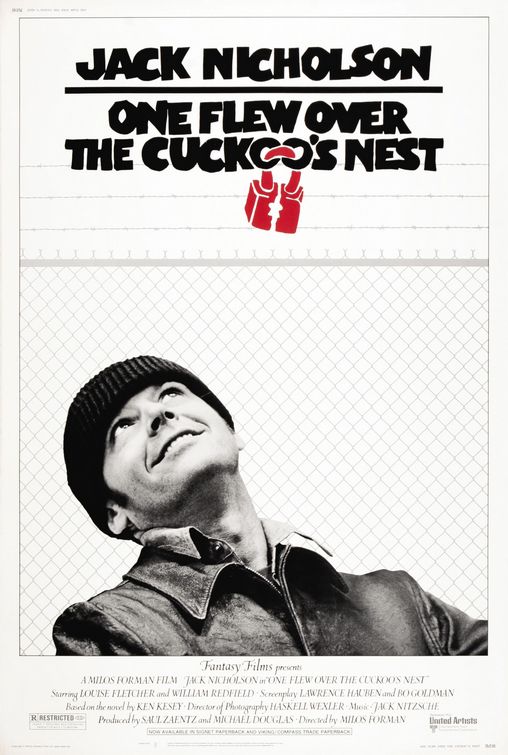 'One Few Over the Cuckoo's Nest' shows a progressive view of mental illness, considering when the film was made.
The film highlights the injustice of the psychiatric field in the 1960s. This injustice is demonstrated through the film's protagonist, Randle McMurphy, who is locked away after faking madness to get out of hard labour. Despite this, a lobotomy is ordered by the doctors who are meant to be caring for him.
This film forces the audience to question who is and is not 'mentally ill'. Since the 1970s, treatment of the mentally ill has vastly improved, but the film has a similar impact today as it would have done 40 years ago as it breaks down the wall between 'normal' and 'abnormal'.
Within 'One Flew Over the Cuckoo's Nest' society clearly has a lack of respect for the mentally ill, as they are seen as a threat. The workers at the institution see them as animals which they can poke and prod at will. This creates a sense of sympathy in the audience, but also creating a respect for those suffering from mental illness.
This progressive representation is very different to the typical regressive representation of the mentally ill in the older examples. These would often portray mentally ill people as outcasts of society, forced to take medication to change who they are.
New Representations:
Mary and Max (2009) -
 Modern films tend to have a more progressive outlook on mental illness, a good example of this is 'Mary and Max'. At first the characters' mental illness is very subtle as it is not made explicit and is just a part of their personality. The film covers the various hardships of having a mental illness. Mary, an eight-year-old girl from Australia, suffers with depression and Max, a 44-year-old obese man from New York, has Asperger syndrome.
The world in which the film is set is show through the minds of the two main characters, demonstrating the harsh reality of mental illness. However, despite this it brings the two together who find friendship as they send letters back and forth over the course of several years, forming a close bond due to their various shared mental and social problems. This is heart-warming for the audience and creates a sense of normality around their mental issues as they value their friendship just as much as anyone else would despite their quirks.
It is not just the two main characters that have mental or social issues/differences. In fact, early all of the characters have some sort of issue whether it be physical or mental. Mary's mother has a severe drinking problem, as well as kleptomania (the inability to refrain from the urge to steal things). Her neighbour has agoraphobia (an anxiety disorder that leads to the person perceiving an environment as unsafe with no easy way to get away), and Mary's Greek Australian neighbour, who she later marries, eventually turns out to be homosexual (not a mental illness or social issue but was not a social norm in the 60s when this film is set).
The film covers a vast number of themes surrounding mental illness, such as; childhood neglect, friendship, loneliness, obesity, suicide, isolation and anxiety. However, because these themes are covered from the perspective of the characters, they are not skewed or restrained. This is very progressive in terms of giving the audience an accurate representation of mental illness within the film.

No comments:
Post a Comment